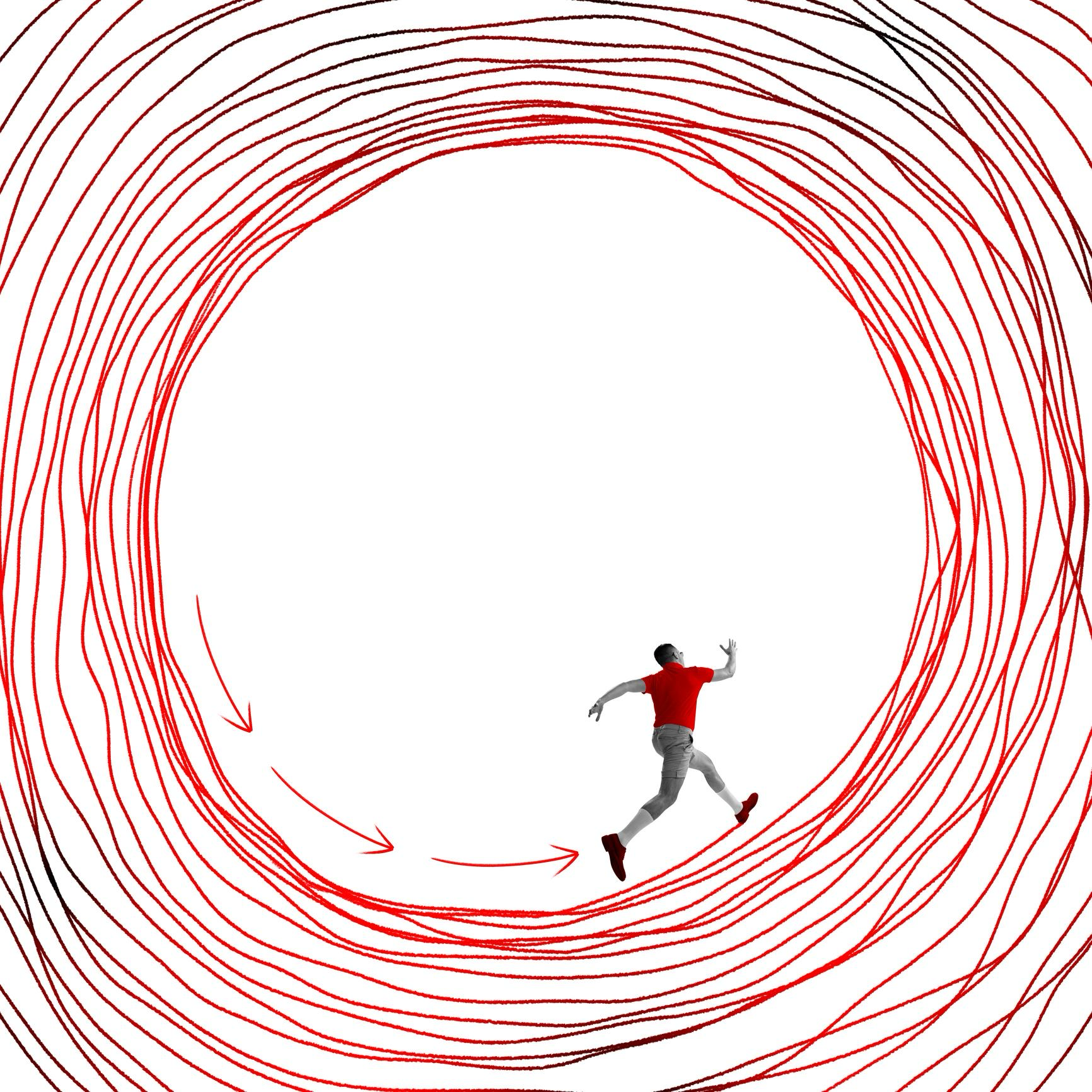
Obsession to Destruction — The Slippery Path of the Mind
In my professional work, I often encounter individuals who feel trapped — not by external circumstances, but by internal patterns they cannot seem to break.
These patterns may revolve around thoughts, routines, relationships, or specific outcomes. In clinical language, this is often categorized under OCD (Obsessive-Compulsive Disorder).
Most individuals who reach therapists like me have already tried multiple approaches — often including medication — yet something within the cycle continues.
This is where an interesting perspective emerges.
I have always seen the Bhagavad Gita not merely as a spiritual text, but as a deeply accurate psychological manual — expressed in spiritual language.
And what it offers is not just insight into the mind…
but a step-by-step map of how the mind loses its balance.
🔍 Where It Actually Begins
Contrary to popular belief, the breakdown does not begin with obsession.
It begins much earlier — with something extremely subtle:
👉 Repetitive thinking
When the mind repeatedly dwells on something — a person, an idea, a fear, a desire — it begins to form a connection.
This connection is what the Gita calls attachment.
At this stage, everything still appears normal.
There is no visible problem.
⚠️ The Critical Shift: Attachment → Obsession
Attachment in itself is not destructive.
Attachment says: “I prefer this.”
But over time, something shifts:
Obsession says: “This must happen.”
This shift is extremely subtle — and often goes unnoticed.
What was once a preference becomes a psychological necessity.
This is what the Gita describes as:
👉 From attachment arises craving
And this craving is what we are calling obsession.
🔁 When Reality Doesn’t Cooperate
The real friction begins when life does not align with this internal demand.
When what “must happen” does not happen, the system reacts.
This reaction shows up as:
Frustration
Irritation
Anger
Restlessness
And gradually, something deeper begins to shift.
🧠 The Collapse of Clarity
According to the Gita, this is where the internal breakdown accelerates:
Anger leads to delusion
→ The person starts losing objective perception
Delusion leads to memory distortion
→ They forget what they know, what they’ve learned, what is true
Memory distortion leads to loss of intelligence
→ Decision-making collapses
Loss of intelligence leads to destruction
→ Not necessarily physical — but psychological, emotional, and functional
🔄 The Birth of Compulsion
This is the stage most people recognize.
👉 Compulsion
“Without this happening, I cannot rest.”
At this point:
The person is no longer choosing
The mind is no longer flexible
The system is caught in a loop
Repeating actions, thoughts, or behaviors — not out of desire,
but out of inner pressure and discomfort
💡 The Most Important Insight
Compulsion is not the beginning of the problem.
It is the final stage of a long, unnoticed process.
By the time compulsion appears,
the internal system has already gone through multiple layers of distortion.
🔑 Where Awareness Can Change Everything
There is, however, a powerful intervention point.
It is not at the stage of compulsion.
It is not even at the stage of obsession.
It is here:
👉 When attachment starts becoming unreasonable
That moment when:
A preference starts feeling like a necessity
A thought starts repeating more than it should
An outcome starts feeling non-negotiable
If awareness is brought in at this stage,
the entire chain can be interrupted.
🔥 Closing Reflection
The mind does not collapse suddenly.
It slips.
Slowly.
Silently.
Logically.
From:
Thinking → Attachment → Obsession → Compulsion → Breakdown
And the earlier we notice the shift,
the less we have to repair later.
✨ Final Line
Compulsion is not the problem.
It is the final expression of unnoticed attachment.
And awareness — at the right moment —
is enough to change the entire direction.